Starbucks
Semester-long market research project with a three-person team. We evaluated Starbucks' "Hello Again" campaign — a brand repositioning launched in February 2025 after declining sales and a CEO change — testing whether campaign awareness drove measurable shifts in brand attitude.
The Problem
By mid-2024, Starbucks was struggling: comparable store sales dropped 6%, transactions fell 10%, and a CEO change brought Brian Niccol from Chipotle. In response, Starbucks hired Anomaly and launched "Hello Again" — personalized cup messages ("That's Not My Name"), longer in-store visits ("Stay Awhile"), and free refills. Nine months in, there was no clear evidence customers had noticed. Our question: how effective has "Hello Again" been at changing how people see Starbucks?
Methodology
Four phases of primary research, each building on the last: informational interviews, 11 in-depth interviews with customers aged 13 to 81, observation of 57 customers at a Charlottesville Starbucks (yielding three behavioral segments — workers, socializers, and to-go customers), and a 12-question structured survey of 101 U.S. respondents via Amazon Mechanical Turk. We measured attitudes first, then awareness, using a funnel method to avoid priming, and analyzed the data in R with t-tests, chi-square, ANOVA, and Spearman correlations.
Findings
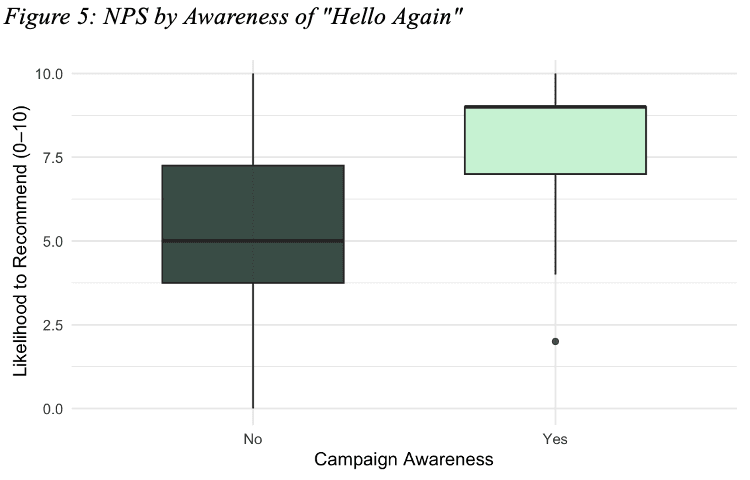
Campaign awareness was very low: 71% of customers had never heard of "Hello Again" by name. But among the 29% who had, brand perception was stronger across every measured area (personal, authentic, experiential — each at p < .001), and average NPS was 8.03 versus 5.10 for the unaware. Limited reach, strong measurable impact.
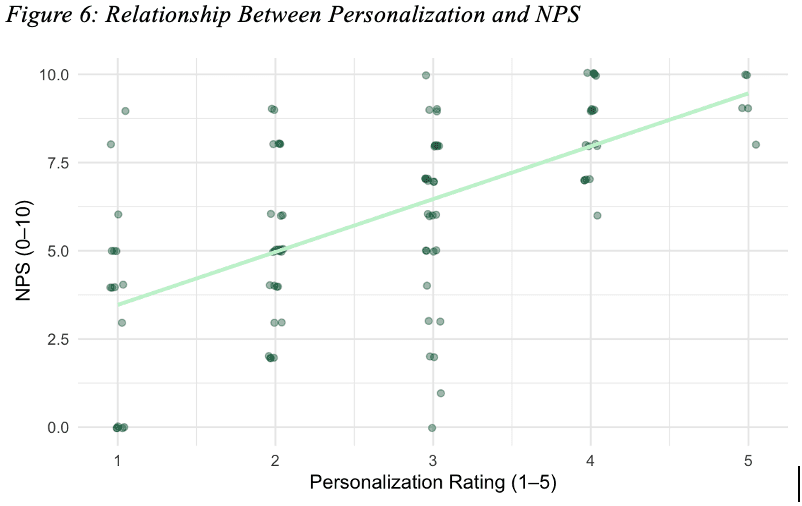
The best predictor of recommendation wasn't awareness — it was how personalized the experience felt (Spearman's ρ = 0.62, p < .001). Small touches like handwritten cup messages did more for loyalty than the broader "Stay Awhile" idea.
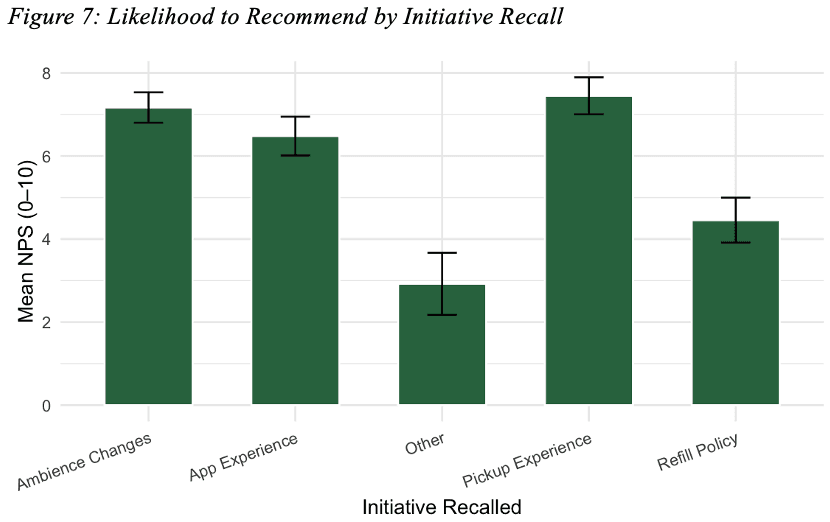
And "Stay Awhile" targets a small group: 57% of customers spend under 10 minutes in store. The factors that most improved NPS were the pickup and app experiences — what matters to the grab-and-go majority.
Reflection
This project taught me to design research backward from the claim I wanted to be able to test. While my Statistics background has grounded my fluency in data synthesis, primary research for non-academic studies was new to me. Structuring the survey with a clear IV/DV logic — attitudes before awareness — meant our findings could withstand the selection-bias question rather than dodge it. It also showed me that the most useful finding is often the uncomfortable one: the campaign worked, just not where Starbucks was pointing it.
Deliverables
Loading PDF…